Posts

Quentin Tarantino, Hotline Miami, and Stylized Violence
Image
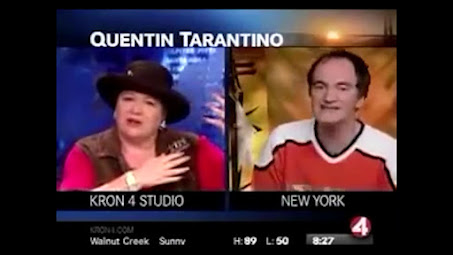
  1. "Because it's so much fun, Jan, get it!" Watch enough interviews with Quentin Tarantino on YouTube and you will inevitably wind up with this clip from his 2003 appearance on KRON 4 in your recommended tab. For the three of you reading this who haven't seen it and don't particularly care to, it's a publicity piece gone bad. Jan Wahl, critic for KRON-TV and various San Francisco based newspapers, antagonizes Tarantino until he snaps, dredging up every talking point about preserving children's innocence along the way. After some quibbling back and forth between the two about whether or not the film empowers women, Wahl asks, "Why the need for so much gruesome, graphic violence?" To which an exasperated Tarantino responds, "Because it's so much fun, Jan, get it!" What follows is a conversation that has been had and had and had again since Moe first slapped Curly. "I'd like to see you get attacked by some kids who had just...

Hollywood Haikus

I. "I am big," she said. "It's the pictures that got small." Here comes your close-up.   II. The leading man's face Appears shrouded, black and white-- Chiaroscuro.   III. Sanjuro went to Italy, where he soon became The Man With No Name. IV. She was a star, once. Now they say she's just another Sad back lot lizard.

James Ellroy, Frank Stanford, and Literary Pointillism

Image
Coined in the late 1880s to deride the works it describes, “pointillism” refers to a style of Impressionistic painting that employs discrete points of color that, when viewed from a distance, cohere into a single image. Notable pointillist artworks include Georges Seurat’s 1886 A Sunday Afternoon on the Island of La Grande Jatte and Roy Lichtenstein’s 1964 Ohhh… Alright (pictured below), both of which--despite the nearly eighty years between them--serve as near perfect examples of the style. They are images created in composite; every individual dot relies on its neighbor for meaning.   The literary works of James Ellroy and Frank Stanford operate based on a similar principle. In Ellroy’s later novels and throughout Stanford’s poetry, each sentence (or line, as the case may be) typically contains a single image, emotion, or action. As one sentence/line builds on the one before it and segues into the next, the scene or scenario takes shape in the reader’s mind.   Obviously, th...

An Uninspired Analysis of William Dean Howells' "Editha"

And I looked, and behold a pale horse: and his name that sat on him was Death, and Hell followed with him. And power was given unto them over the fourth part of the earth, to kill with sword, and with hunger, and with death, and with the beasts of the earth.        Revelation 6:8   “Mein Führer, I can walk!”      Dr. Strangelove or: How I Learned to Stop Worrying and Love the Bomb Published seven years after the conclusion of the Spanish-American War, William Dean Howells’ short story “Editha” concerns the process whereby the titular character convinces her fiance, one George Gearson, to enlist. After some cajoling on Editha’s part, George does finally volunteer to fight. George goes to war. George fights. And George dies. So it goes. Editha’s role in the story turns the Spanish-American War into a bizarre psychosexual drama. George’s willingness to fight for his country becomes confused with his willingness to fight for Edi...

The Sunny Gothicism of The Lost Boys

  1. Sunshine Gothic Smallpox and genocide. Rice hats and rail road ties. Flashbulbs and bathtub gin. Paranoia and internment camps. LSD and free love. Welcome to sunny California--the place where the scarlet wave of Manifest Destiny finally broke and rolled back, leaving those unlucky enough to get caught up in the undertow gasping for breath on the surf; the place where a hard bitten, bootlegging Irishman bankrolled cheap flicks and laid the foundation for Camelot; the place where Sunshine Gothic was born. Coined by Twitter user @blauer_geist , the term "Sunshine Gothic" refers to a loose connection of media artifacts united by their collective preoccupation with the American west coast generally and California specifically. In many respects, Sunshine Gothic can be understood as a reaction to the 1969 Tate-LaBianca murders. @blauer_geist writes, "The Manson rituals, committed 50 years ago during the dog days of 1969, occurred at the intersection of 'Devil's wor...

Miscellaneous Thoughts on Lars von Trier's The House That Jack Built

To call this a review, or an analysis, or anything of the sort would be more than just misleading; it would be deceitful. I have no interest in drawing parallels between The House That Jack Built and Dante's Inferno , nor do I have much to say about the quality of von Trier's film beyond, "It's worth watching." Regardless, I do feel compelled to say something about it, specifically about how it ends. If you haven't seen it, fuck you, I'm not going to summarize it here. But, that Jack is unable to successfully skirt around the edge of the hell mouth and enter Heaven seems to me to be a refutation of his philosophy. A philosophy which Jack/von Trier is overly eager to explain to Verge/the audience, and a philosophy which--at least at first brush--appears to have quite a lot in common with Arthur Machen's formulation of artistic ecstasy.

Notes Toward a New Theory of Enchantment

Montague Rhodes James (1862-1936), better known as M. R. James, was an English medievalist and scholar whose work, though primarily published in the early years of the twentieth century, remains highly regarded today. His distinction in the field secured him a position as provost at Eton and, later, at King’s College in Cambridge. In addition to his contributions to medieval studies, James is widely hailed as the progenitor of the “antiquarian ghost story”; a variation on the classic supernatural tale that updates traditional Gothic tropes and brings them into conversation with the trivial banalities of modern life, with predictably stange and horrific results. The haunted object is a recurring motif in James’ fiction. Rather than tethering his vengeful spirits and tormented souls to specific locations, James often opted instead to attach his ghosts to manuscripts, paintings, and other such objets d’art . His protagonists are almost invariably academics of some description: the curator...