Posts

The Big Bang Theory Theory

Image
  The Anxiety of Influence In the preface to the second edition of The Anxiety of Influence , Bloom uses Shakespeare’s artistic struggle against Marlowe to explain the Bard’s development as a playwright and poet. Of particular interest is his comparison of Shakespeare’s The Merchant of Venice and Marlowe’s The Jew of Malta . Marlowe’s Barabas is an outright caricature; an unrepentantly evil figure cobbled together from centuries of anti-Semitic propaganda. Shakespeare’s Shylock, meanwhile, is presented as a complicated man who nonetheless falls into the same behaviors as his antecedent. Shylock is not so easily dismissed as Barabas, Bloom argues, and it is for this reason he is a more pernicious character. Shylock at once confirms the audience’s anti-Semitic prejudices while also allowing them to feel as though they’ve given him a fair shake and still found him wanting.   "One by one, they all just fade away..." A similar dynamic has played out between Chuck Lorre and Dan Ha...

Print the Legend: How Tarantino Saved Us from the 1980s

Image
I’ve been driving a lot recently, which means I’ve been listening to a lot of podcasts. Back episodes, mostly. Weird Studies, Slothcast, Tales from the Mall, and Bad Books for Bad People were all on heavy rotation for a while. Then I got on a Quentin Tarantino kick. He has two ridiculously long appearances on The Joe Rogan Experience and on The Empire Film podcast. They’re both good. I’m probably the last person who’s listened to them. During both interviews, Tarantino pitches the 1980s as a time of cultural stagnation and self censorship. “They won’t let you do that,” was the rule of the day. “They” being the studios (and the viewing public said studios supposedly represent) and “that” being anything overtly violent or sexual. That is, until he came out with Reservoir Dogs in 1992 and single handedly changed the landscape of American cinema. Without Reservoir Dogs , Tarantino argues, we wouldn’t have gotten Se7en or American Beauty . We also wouldn’t have gotten The Boondock Saints ...

Represent and Stake: Vampirism and the American Race Novel

Image
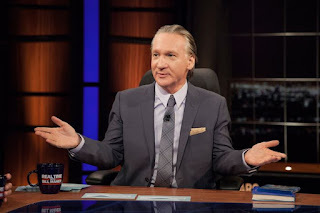
Both Richard Matheson’s I Am Legend and Charlaine Harris’ Sookie Stackhouse novels (and the adaptations thereof) use vampires as a stand-in for marginalized and/or oppressed groups. In I Am Legend , the vampires are the proletariat; in the Stackhouse books they are variously homosexuals, the X-Men, people of color, et cetera. But where in Matheson’s novella the vampires employ violent means to achieve their Revolutionary ends, Harris’ bloodsuckers take a somewhat subtler approach; opting instead to ingratiate themselves to mortals by appearing opposite Bill Maher on Real Time and opening integrated bars where the undead can mix and mingle with the living. Bill Maher, circa 2008   This evolution in vampiric praxis reflects a sea-change in American politics. When Matheson published I Am Legend in 1954, it likely seemed as if the only way any subversive ideology could gain a foothold in the United States was through violence. Thus, They came at sunset, muttering, snarling, screamin...

Joss, Call Me Back

Image
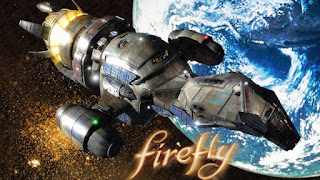
Firefly is a fun show. There’s no denying that. “Wagon Train to the Stars” is a winning concept, as the dozens of Star Trek spin-offs and clones can attest. So long as there are televisions, there will be fat nerds to sit in front of them. I hear The Expanse is doing well. But it isn’t the mystery some people seem to think it is that Firefly got cancelled after just one season: characters routinely act contrary to what the audience is told about them; the set design, while charming, is pretty janky; and Joss Whedon’s dialogue fucking blows, to say nothing of his other proclivities. The list goes on. A cool concept only gets you so far. The Serenity   The problem is they didn’t do anything with the concept. The crew of the Serenity are essentially ex-Confederate guerillas… in SPACE . Firefly could’ve been The Outlaw Buck Rogers , but wound up being closer to Little House on the Planet than anything else. It’s the anti- Trek . The core conceit of the show is an indictment of Ro...

“Your Existence is a Mistake!”: A Reflection on That Cold Dead Look in Your Eyes

Image
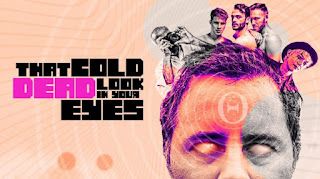
 1. “Your existence is a mistake!” That Cold Dead Look in Your Eyes   That Cold Dead Look in Your Eyes / Tes Yeux Mourants is a black-and-white existential horror film from visionary painter, actor, and filmmaker Onur Tukel. The film follows Andy (Max Casella) as his personal life descends into chaos against a backdrop of mind bending WiFi signal boosters and grim promises of a coming plague. It’s topical, but That Cold Dead Look in Your Eyes manages to transcend its contrivances to deliver a story that’s as timeless as it is bleak. That Cold Dead Look in Your Eyes opens--in color--on a happy couple in the process of furnishing their apartment. Andy jokes that his girlfriend (Nora Arnezender) is obsessed with her father Dennis (Alan Ceppos), a world-renowned photographer whose pictures cover nearly every wall of their shared residence. But by the opening credits, the couple’s relationship has soured and reality itself has seemingly begun to decay as well. Everything is blac...

Conan the Barbarian and Schwarzenegger's Pecs as Visual Metaphor

Image
In an effort to make my corpus more legible to future biographers, I’ve decided to distill/recycle some of my Twitter threads into long(er) form blog posts. What follows is an attempt to do just that. Here’s hoping I was successful. Robert E. Howard’s Conan cycle is fantasy as only an American--and more specifically, a Texan --could conceive of it. Here are tales of degenerate wizards and brave warriors; of monsters and other, less nameable, things lurking in dank dungeons. The crenellated walls of Castle Camelot are as far from the decadent cities of Hyboria as the verdant forests of Wales are from the desolate oil fields of Texas, as are Arthur’s high minded notions of noble chivalry and Christian honor from the titular barbarian’s ethos of rugged individuality and brute strength. Indeed, Howard inaugurated an entirely new sub-genre with the Conan stories; Sword and Sorcery. Robert E. Howard Described by Fritz Leiber in the late 1960s as “an earthier sort of fantasy,” Sword and Sorce...

Towards a New Urban Fantasy

Image
“You are mad, boy, absolutely mad! Vidocq--Rocambole! You mix up legend and history, bracket murderers with detectives, and make no distinction between right and wrong! You would not hesitate to set the heroes of crime and the heroes of law and order on one and the same pedestal!” --President Bonnet chastising Charles Rambert in the opening pages of Fantȏmas New York City It is my contention that the urban fantasy novel ought not simply drop orcs, goblins, wizards, and the like into, say, New York City or Los Angeles and call it a day, but rather that it should work toward making the urban fantastic . The pulp literature of the 1910s, 20s, 30s, and 40s is far closer to my vision of what urban fantasy could be than something like Shadowrun or even Jim Butcher’s Dresden Files . Marcel Allain and Pierre Souvestre’s Fantȏmas , Mickey Spillane’s Mike Hammer novels, and Dashiell Hammett’s Continental Op stories all elevate cops and criminals to the level of epic heroes-- this is what urba...

Asura Snow

Image
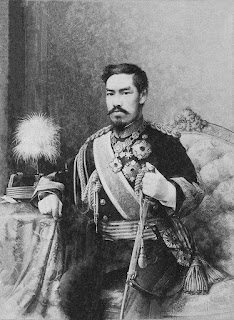
1. Meiji Japan Emperor Kōmei succumbed to smallpox on January 30th, 1867. The Edo period died with him. His fourteen year old son Prince Mutsuhito assumed the Chrysanthemum Throne on October 23, 1868 and was re-christened “Emperor Meiji.” Too young to govern at the time of his ascension, the child emperor’s advisors assumed control of Japan and quickly set about modernizing the island nation: old systems of feudal hierarchy were abolished, the so-called “evil customs” of the past were broken off, and thus were the foundations of imperial rule laid. Emperor Meiji Early Meiji reformers believed such reforms were necessary for achieving diplomatic equality and military strength. The motto of the era was “Enrich the Country and Strengthen the Military.” Emperor Meiji embodied these efforts. He wore Western-style military clothing, styled his hair after the Western fashion, and grew a kaiser mustache all in an effort to appear more “civilized” to the outside world. 2. Lady Snowblood Toshiya...

The Bonnie and Clyde Death Car as Futurist Masterpiece

Image
The name Jackson Pollock is synonymous with drip painting, a technique that involves flinging and dripping thinned enamel paint onto an outstretched canvas laid on the floor of a studio. His body of work is less about the ultimate product than it is about the process . Number 17A is the record of a performance. This was a revelation for the coastal gallerists of 1950-whatever. Number 17A was art as artifact: it was bold; it was daring; it was, they thought, new . But, as is often the case, roadside hucksters were ahead of the art world by a good ten or fifteen years. Number 17A On May 23, 1934, a cadre of brave policemen ambushed Bonnie Elizabeth Parker and Clyde Chestnut Barrow as the couple drove down a back road somewhere in rural Louisiana. Bonnie was eating a sandwich in the passenger seat when a Texan rifleman appeared and shot Clyde in the head. Clyde’s mind was blown into the back seat. He died instantly. Bonnie had just enough time to get off one last bone-chilling scream b...

Terminator, The Exorcist III, and the Evolution of the Jump Scare

Image
     Magic relies on misdirection. Watch my left hand as my right adds another ace to the deck. Focus on my voice while I stuff this rabbit into my hat. Look at this buxom blonde “assistant” I picked up outside as I sneak off backstage and “disappear.” Etc., etc.. James Cameron achieves a similar effect in this iconic scene from Terminator .      The insert shots of the cop filling out paperwork are there to distract you until it’s too late and Schwarzenegger’s driving a car through the front window--a pyrotechnic prelude to the massacre to come. Cameron deprives the audience of crucial information, making it nearly impossible for you, the viewer, to accurately anticipate what is going to happen next.      The nearly five minute long nurse station scene from The Exorcist III operates on the exact opposite principle. William Peter Blatty provides you with altogether too much information. Will the Gemini Killer jump out from behind that desk...

A Love Letter to Jurassic Park

Image
     Long before I became a Z-list internet personality, I had it in my head I was gonna be a paleontologist. I was the quintessential dinosaur kid. I spent hours of my childhood leafing through Gurney’s Dinotopia books, The Ultimate Dinosaur , and later, as my childhood obsession grew into something slightly more scholarly, Greg Paul’s The Princeton Field Guide to Dinosaurs and Anthony J. Martin’s Dinosaurs Without Bones . So of course I’ve seen Jurassic Park more times than I can count.      It would probably be more dramatic if I said I remember the first time I saw Jurassic Park like it was yesterday, but the simple truth is I don’t. In all honesty, I can’t remember a time when I hadn’t seen it--images from the film are so embedded in my psyche it’s like they were there before me, waiting. When I’m on my deathbed and my life is flashing before my eyes, the chances that stills from Jurassic Park will be interspersed between memories of my beloved w...

Notes on "Notes on Writing Weird Fiction" (and Call of Cthulhu Scenarios)

     Some time ago Jack Guignol made a post applying Edgar Allen Poe’s “The Philosophy of Composition” to tabletop role playing game source books in which he emphasizes the importance of concision, method, and clarity or “unity of effect.” I find myself in agreement with most of his conclusions, though I will readily admit my weakness for overwrought (and overly long) flavor text in RPGs. But I digress.      While listening to the Weird Studies episode “On Lovecraft” it occurred to me that certain insights from H. P. Lovecraft’s “Notes on Writing Weird Fiction” could be applied to the process of writing scenarios and campaigns for Chaosium’s Call of Cthulhu in much the same way. Around the half hour mark of the podcast, Phil Ford comments that what he finds most interesting about the methodology Lovecraft outlines in the short essay is “his insistence that the heart of the story is a basically atemporal thing--is basically just this flash of image or...

A/S/L?: A Brief Reflection on Contemporary Blasphemy and LaVeyan Satanism

Image
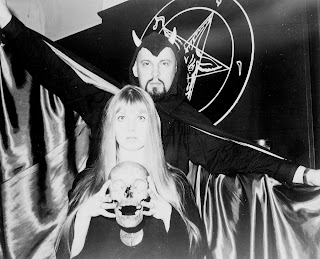
     Published to great controversy in 1969, Anton Szandor LaVey’s grimoire The Satanic Bible is a collection of essays and observations extolling the virtues of selfishness and instinct. The text is foundational to LaVeyan Satanism, containing, as it does, the central tenets and dogma of his philosophical project. But despite The Satanic Bible ’s sordid reputation, it reads more like a Twitter PUA’s guide to tricking a weird goth girl into bed than it does a sequel to the Kitab al-Azif . Anton Szandor LaVey, the high priest of Satanism himself      Nevertheless, LaVey does manage to include some interesting anthropological insights regarding the persistence of the religious instinct, even in the face of psychoanalysis. From pages 52-53 of The Satanic Bible : Modern man has come a long way; he has become disenchanted with the nonsensical dogmas of past religions. We are living in an enlightened age. Psychiatry has made great strides in enlightening man abo...

William Marshall’s Dead: Blade, Blaxploitation, and Gothic Punk

    Following the release of Ryan Coogler’s 2018 blockbuster Black Panther , many publications--popular and academic alike--heralded it as a decade defining film. From Time : “The Revolutionary Power of Black Panther ”; from Esquire : “Why Black Panther Is History in the Making”; from The New York Times : “Why Black Panther Is a Defining Moment for Black America”; the list goes on. Indeed, Black Panther ’s cultural impact was quite impressive. In the months that followed its debut, dozens of celebrities were seen flashing the “Wakanda Forever” salute popularized by the film up and down Sunset Boulevard, Walmarts the world over struggled to keep T’Challa action figures in stock, and children and manchildren alike were united in their collective worship of a man in black polyester catsuit. Black Panther mania came to a head at that year’s Oscar’s, where the film was nominated for Best Original Score, Best Production Design, Best Costume Design, Best Sound Mixing, Best So...

The Conjuring 3: Too Vulgar a Display of Power

    Full disclosure: I haven't seen The Conjuring since sometime around 2015, and I haven't re-watched The Conjuring 2 since it first came out in theaters. I've also only done cursory research into the case The Conjuring 3 is purportedly based on, so what follows relies almost solely on my admittedly spotty memory and Wikipedia tinged conjecture.     The tent pole Conjuring films--that is, The Conjuring , The Conjuring 2 , and now, The Conjuring 3: The Devil Made Me Do It --each open with Ed and Lorraine Warren investigating a supernatural occurrence of some description. If memory serves, The Conjuring begins with the duo removing the Annabel doll from a young couple's home; The Conjuring 2 with Ed and Lorraine poking around Amityville. Both of these scenes serve to 1). (re)introduce the Warrens to the audience and 2). establish the thematic concerns of the installment. Neither of these scenes is integral to the movie's A plot. (I think Valak or whatever th...

Quentin Tarantino, Hotline Miami, and Stylized Violence

Image
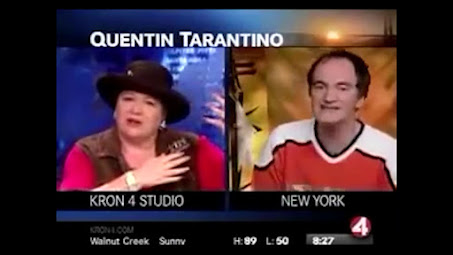
  1. "Because it's so much fun, Jan, get it!" Watch enough interviews with Quentin Tarantino on YouTube and you will inevitably wind up with this clip from his 2003 appearance on KRON 4 in your recommended tab. For the three of you reading this who haven't seen it and don't particularly care to, it's a publicity piece gone bad. Jan Wahl, critic for KRON-TV and various San Francisco based newspapers, antagonizes Tarantino until he snaps, dredging up every talking point about preserving children's innocence along the way. After some quibbling back and forth between the two about whether or not the film empowers women, Wahl asks, "Why the need for so much gruesome, graphic violence?" To which an exasperated Tarantino responds, "Because it's so much fun, Jan, get it!" What follows is a conversation that has been had and had and had again since Moe first slapped Curly. "I'd like to see you get attacked by some kids who had just...