Posts

A/S/L?: A Brief Reflection on Contemporary Blasphemy and LaVeyan Satanism
Image
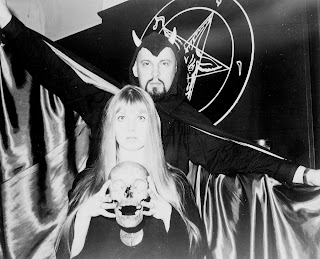
     Published to great controversy in 1969, Anton Szandor LaVey’s grimoire The Satanic Bible is a collection of essays and observations extolling the virtues of selfishness and instinct. The text is foundational to LaVeyan Satanism, containing, as it does, the central tenets and dogma of his philosophical project. But despite The Satanic Bible ’s sordid reputation, it reads more like a Twitter PUA’s guide to tricking a weird goth girl into bed than it does a sequel to the Kitab al-Azif . Anton Szandor LaVey, the high priest of Satanism himself      Nevertheless, LaVey does manage to include some interesting anthropological insights regarding the persistence of the religious instinct, even in the face of psychoanalysis. From pages 52-53 of The Satanic Bible : Modern man has come a long way; he has become disenchanted with the nonsensical dogmas of past religions. We are living in an enlightened age. Psychiatry has made great strides in enlightening man abo...
William Marshall’s Dead: Blade, Blaxploitation, and Gothic Punk

    Following the release of Ryan Coogler’s 2018 blockbuster Black Panther , many publications--popular and academic alike--heralded it as a decade defining film. From Time : “The Revolutionary Power of Black Panther ”; from Esquire : “Why Black Panther Is History in the Making”; from The New York Times : “Why Black Panther Is a Defining Moment for Black America”; the list goes on. Indeed, Black Panther ’s cultural impact was quite impressive. In the months that followed its debut, dozens of celebrities were seen flashing the “Wakanda Forever” salute popularized by the film up and down Sunset Boulevard, Walmarts the world over struggled to keep T’Challa action figures in stock, and children and manchildren alike were united in their collective worship of a man in black polyester catsuit. Black Panther mania came to a head at that year’s Oscar’s, where the film was nominated for Best Original Score, Best Production Design, Best Costume Design, Best Sound Mixing, Best So...

The Conjuring 3: Too Vulgar a Display of Power

    Full disclosure: I haven't seen The Conjuring since sometime around 2015, and I haven't re-watched The Conjuring 2 since it first came out in theaters. I've also only done cursory research into the case The Conjuring 3 is purportedly based on, so what follows relies almost solely on my admittedly spotty memory and Wikipedia tinged conjecture.     The tent pole Conjuring films--that is, The Conjuring , The Conjuring 2 , and now, The Conjuring 3: The Devil Made Me Do It --each open with Ed and Lorraine Warren investigating a supernatural occurrence of some description. If memory serves, The Conjuring begins with the duo removing the Annabel doll from a young couple's home; The Conjuring 2 with Ed and Lorraine poking around Amityville. Both of these scenes serve to 1). (re)introduce the Warrens to the audience and 2). establish the thematic concerns of the installment. Neither of these scenes is integral to the movie's A plot. (I think Valak or whatever th...

Quentin Tarantino, Hotline Miami, and Stylized Violence

Image
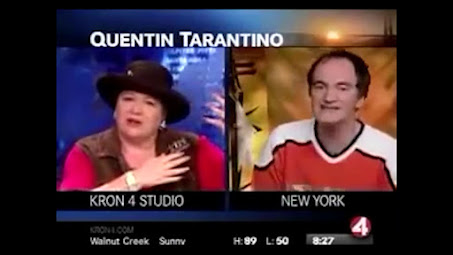
  1. "Because it's so much fun, Jan, get it!" Watch enough interviews with Quentin Tarantino on YouTube and you will inevitably wind up with this clip from his 2003 appearance on KRON 4 in your recommended tab. For the three of you reading this who haven't seen it and don't particularly care to, it's a publicity piece gone bad. Jan Wahl, critic for KRON-TV and various San Francisco based newspapers, antagonizes Tarantino until he snaps, dredging up every talking point about preserving children's innocence along the way. After some quibbling back and forth between the two about whether or not the film empowers women, Wahl asks, "Why the need for so much gruesome, graphic violence?" To which an exasperated Tarantino responds, "Because it's so much fun, Jan, get it!" What follows is a conversation that has been had and had and had again since Moe first slapped Curly. "I'd like to see you get attacked by some kids who had just...

Hollywood Haikus

I. "I am big," she said. "It's the pictures that got small." Here comes your close-up.   II. The leading man's face Appears shrouded, black and white-- Chiaroscuro.   III. Sanjuro went to Italy, where he soon became The Man With No Name. IV. She was a star, once. Now they say she's just another Sad back lot lizard.

James Ellroy, Frank Stanford, and Literary Pointillism

Image
Coined in the late 1880s to deride the works it describes, “pointillism” refers to a style of Impressionistic painting that employs discrete points of color that, when viewed from a distance, cohere into a single image. Notable pointillist artworks include Georges Seurat’s 1886 A Sunday Afternoon on the Island of La Grande Jatte and Roy Lichtenstein’s 1964 Ohhh… Alright (pictured below), both of which--despite the nearly eighty years between them--serve as near perfect examples of the style. They are images created in composite; every individual dot relies on its neighbor for meaning.   The literary works of James Ellroy and Frank Stanford operate based on a similar principle. In Ellroy’s later novels and throughout Stanford’s poetry, each sentence (or line, as the case may be) typically contains a single image, emotion, or action. As one sentence/line builds on the one before it and segues into the next, the scene or scenario takes shape in the reader’s mind.   Obviously, th...

An Uninspired Analysis of William Dean Howells' "Editha"

And I looked, and behold a pale horse: and his name that sat on him was Death, and Hell followed with him. And power was given unto them over the fourth part of the earth, to kill with sword, and with hunger, and with death, and with the beasts of the earth.        Revelation 6:8   “Mein Führer, I can walk!”      Dr. Strangelove or: How I Learned to Stop Worrying and Love the Bomb Published seven years after the conclusion of the Spanish-American War, William Dean Howells’ short story “Editha” concerns the process whereby the titular character convinces her fiance, one George Gearson, to enlist. After some cajoling on Editha’s part, George does finally volunteer to fight. George goes to war. George fights. And George dies. So it goes. Editha’s role in the story turns the Spanish-American War into a bizarre psychosexual drama. George’s willingness to fight for his country becomes confused with his willingness to fight for Edi...